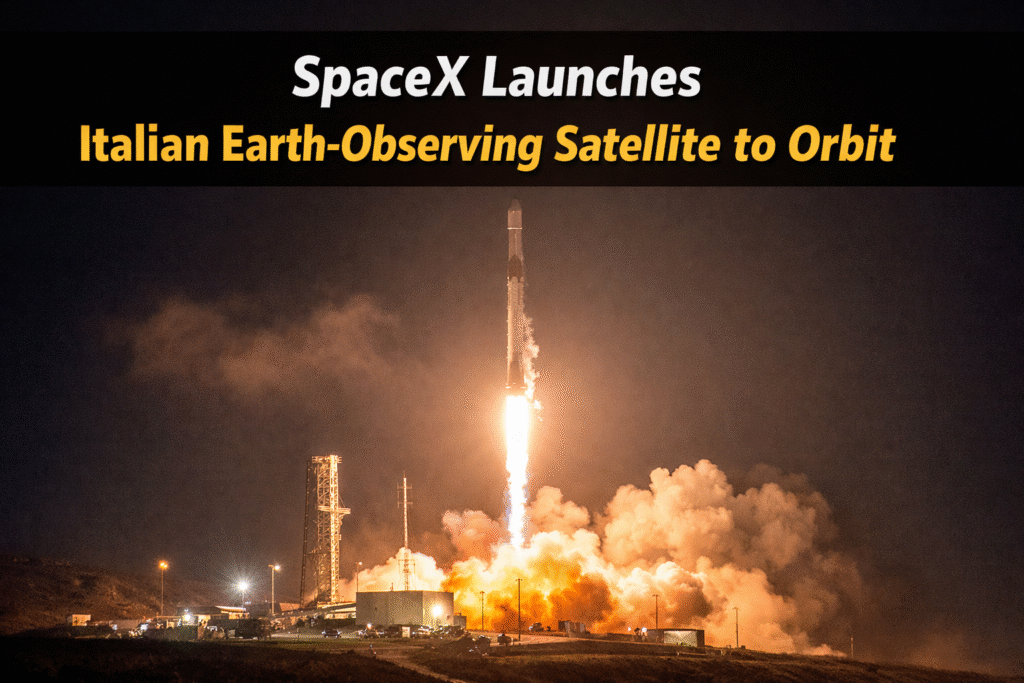
The new year in spaceflight got off to a fast start as SpaceX successfully launched its first mission of 2026 late on January 2, sending an advanced Italian Earth-observation satellite into orbit.
A Falcon 9 rocket lifted off from Vandenberg Space Force Base on the central California coast at 9:09 p.m. EST (6:09 p.m. local time), lighting up the night sky as it headed south over the Pacific Ocean.
Smooth launch and another booster recovery
About eight and a half minutes after liftoff, the rocket’s first stage returned safely to Earth, touching down at Vandenberg exactly as planned. This marked the 21st flight for this veteran booster — another example of SpaceX’s rapid-reuse approach that has reshaped the launch industry.
Roughly four and a half minutes later, the Falcon 9’s upper stage deployed its payload into low Earth orbit: COSMO-SkyMed Second Generation, built for the Italian Space Agency and the Italian Ministry of Defence.
Watching Earth day and night, in any weather
Orbiting about 385 miles (620 kilometers) above Earth, the satellite uses synthetic aperture radar (SAR) technology. Unlike optical satellites, SAR can collect detailed images day or night and through clouds, rain, or smoke, making it especially valuable during emergencies.
According to an explainer from the European Space Agency, the COSMO-SkyMed Second Generation system supports a wide range of uses, including:
Disaster and emergency response
Environmental and forest monitoring
Mapping and cartography
Agriculture and food security
Maritime surveillance
Natural resource and land management
Defense and security applications
This launch brings the total number of COSMO-SkyMed Second Generation satellites in orbit to three. The first launched in December 2019 aboard a Soyuz rocket, followed by a second mission in January 2022 on a Falcon 9.
SpaceX sets the pace again
Starting the year with a successful mission comes as no surprise for SpaceX. The company, led by Elon Musk, completed 165 orbital launches in 2025, more than any other commercial or government organization — and a company record. With 2026 now underway, SpaceX appears poised to challenge that milestone once again.
The launch update was confirmed shortly after liftoff, once the booster landing and satellite deployment were completed successfully.
Where to watch the launch video
You can rewatch the mission and future SpaceX launches on these official platforms:
SpaceX Official Website: https://www.spacex.com/launches
SpaceX on X (Twitter): https://x.com/SpaceX
SpaceX YouTube Channel: https://www.youtube.com/@SpaceX
These sources provide live streams, replays, and mission details directly from SpaceX.