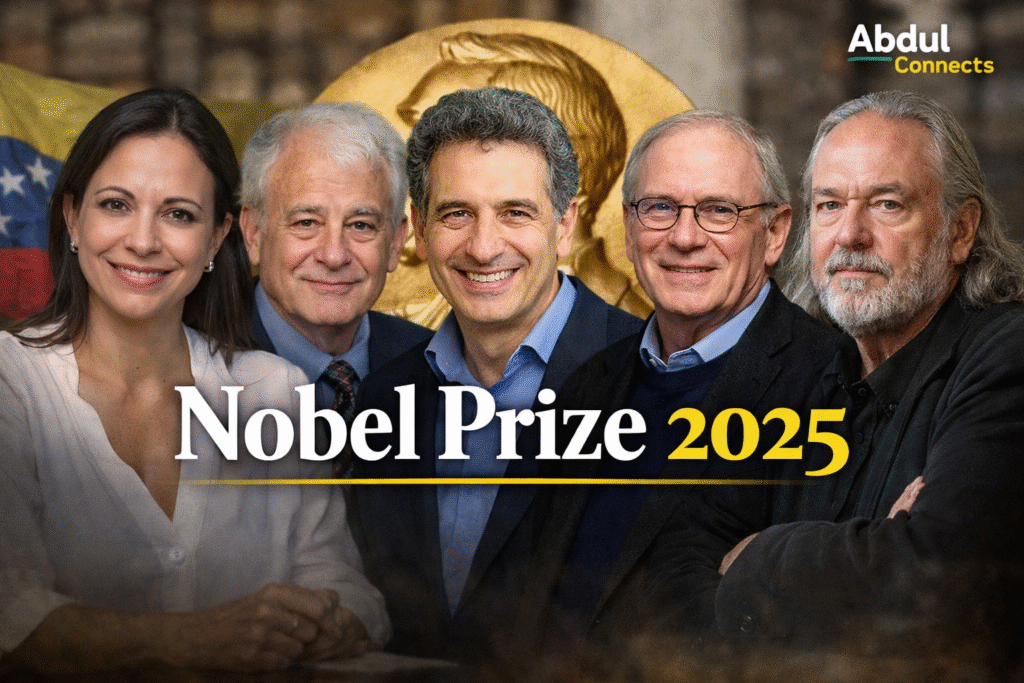
1. María Corina Machado — Nobel Peace Prize 2025
Country: Venezuela
Award: Nobel Peace Prize
Contribution: María Corina Machado was awarded the 2025 Nobel Peace Prize “for her tireless work promoting democratic rights for the people of Venezuela and for her struggle to achieve a just and peaceful transition from dictatorship to democracy.” Wikipedia+1
Background & Education: Born in Caracas in 1967, Machado earned a B.S. in Industrial Engineering at Andrés Bello Catholic University and a master’s in finance from the Instituto de Estudios Superiores de Administración (IESA) in Caracas. She also participated in Yale University’s World Fellows Program in 2009. Wikipedia
Work: Machado has long been a leader in Venezuela’s democratic movement, advocating for electoral integrity and civil liberties despite facing restrictions and going into hiding to avoid political persecution. Wikipedia
Source: Nobel Prize official announcement, NobelPrize.org; Wikipedia biography. Wikipedia+1
2. Joel Mokyr — Nobel Prize in Economic Sciences 2025
Country: Netherlands / Israel / United States
Award: Nobel Memorial Prize in Economic Sciences
Contribution: Mokyr won half of the *Nobel Prize in Economics “for having identified the prerequisites for sustained growth through technological progress.” Wikipedia
Background & Education: Born in Leiden (1946), Mokyr grew up in Israel and studied economics and history at Hebrew University of Jerusalem before receiving his M.Phil. and Ph.D. in economics from Yale University. Wikipedia
Work: A renowned economic historian, Mokyr has explored how science, technology, and culture drive long-term economic growth, emphasizing how innovation shapes modern prosperity. Wikipedia
Source: Nobel Prize records; Wikipedia biography. Wikipedia
3. Philippe Aghion — Nobel Prize in Economic Sciences 2025
Country: France
Award: Nobel Memorial Prize in Economic Sciences
Contribution: Aghion shared the economics prize with Peter Howitt and Joel Mokyr for the “theory of sustained growth through creative destruction,” a model showing how innovation constantly reshapes and fuels economic development. Wikipedia
Background & Education: Born in Paris in 1956, Aghion pursued undergraduate and graduate studies in mathematics before earning advanced degrees in economics, including a Ph.D. from Harvard University. He has held key academic positions at institutions including the Collège de France and the London School of Economics. Wikipedia
Work: His work with Howitt formalized creative destruction in economic theory, explaining how innovation disrupts old industries while powering long-term growth. Wikipedia
Source: Nobel Prize official listing; Wikipedia profile. Wikipedia
4. Peter Howitt — Nobel Prize in Economic Sciences 2025
Country: Canada
Award: Nobel Memorial Prize in Economic Sciences
Contribution: Howitt shared the prize with Aghion and Mokyr for developing models that explain innovation-driven economic growth, especially the mechanisms behind creative destruction. Wikipedia
Background & Education: Born in Guelph, Ontario, Howitt earned a BA in economics from McGill University, followed by an MA from the University of Western Ontario and a Ph.D. in economics from Northwestern University. Wikipedia
Work: Much of Howitt’s research has shaped modern macroeconomic thinking on how technological advancement and market competition influence long-term prosperity. Wikipedia
Source: Nobel Prize information; biographical data from educational institutions. Wikipedia
5. László Krasznahorkai — Nobel Prize in Literature 2025
Country: Hungary
Award: Nobel Prize in Literature
Contribution: Krasznahorkai was awarded the *2025 Nobel Prize in Literature “for his compelling and visionary oeuvre that, in the midst of apocalyptic terror, reaffirms the power of art.”
Background & Education: Born January 5, 1954, in Gyula, Hungary, Krasznahorkai is a celebrated novelist known for works such as Satantango and The Melancholy of Resistance. (General education details are less publicly documented, but he is deeply rooted in Hungarian literary traditions and often engages with philosophy and narrative experimentation.)
Work: His literary output is internationally acclaimed for its dense prose and philosophical depth, exploring human experience in times of crisis.
Source: Nobel Prize official list and literary citation.
Summary of 2025 Nobel Winners (across categories)
Peace: María Corina Machado — democratic rights, Venezuela. Wikipedia
Economic Sciences: Joel Mokyr — innovation and growth; Philippe Aghion and Peter Howitt — creative destruction theory.
Literature: László Krasznahorkai — visionary literary work.
Each laureate’s award highlights impactful contributions to peace, economic understanding, culture, and global welfare in 2025.