
If you’re trying to save money on international airfare in 2026, the biggest “hack” isn’t a secret browser setting or booking at midnight — it’s simply choosing the right day to fly.
Airlines price tickets based on demand. And demand usually spikes around weekends, holidays, and popular departure days. That’s why shifting your trip by even one day can sometimes save you a surprising amount.
Travel outlets and data platforms continue to point to midweek departures as the best bet. For example, Google’s travel reporting has noted that flying Monday through Wednesday can be about 13% cheaper than weekend travel (as cited by The Points Guy, Jan 2, 2026, referencing Google travel trends).
At the same time, not every dataset agrees on the single cheapest day: Expedia’s Air Hacks reporting (Jan 28, 2025) says Thursday can be the cheapest day to fly internationally (and that Sunday can be the most expensive).
So the practical answer is: midweek wins most often, and Thursday can be a strong contender depending on route and season.
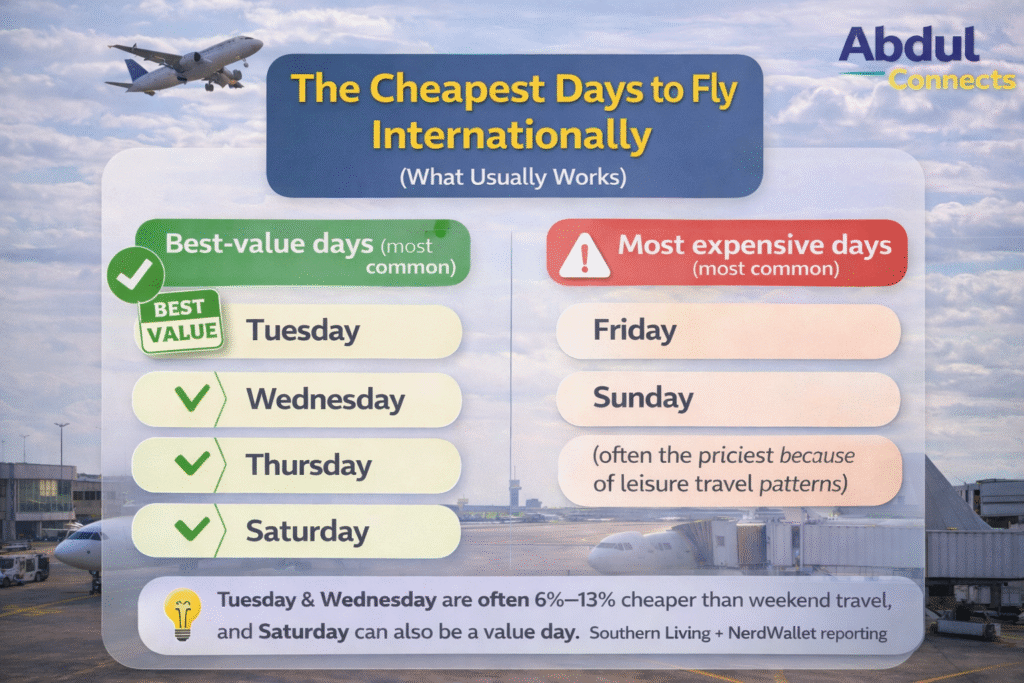
The cheapest days to fly internationally (what usually works)
Here’s the most reliable pattern for U.S. travelers:
Best-value days (most common)
Tuesday
Wednesday
Thursday
Saturday (often cheaper than Friday/Sunday on many routes)
Recent reporting (e.g., Southern Living, published Jan 2026) highlights that Tuesday and Wednesday are often 6%–13% cheaper than weekend travel, and Saturday can also be a value day.
NerdWallet’s travel guidance also commonly points to Wednesday and Saturday as cheaper days for international departures.
Most expensive days (most common)
Friday
Sunday (often the priciest because of leisure travel patterns)
Quick cheat sheet: cheapest vs most expensive days
| Day of the week | Typical price level | Why it happens |
|---|---|---|
| Mon–Wed | ✅ Usually cheapest | Lower demand vs weekend-heavy trips |
| Thursday | ✅ Often competitive | Expedia data has flagged it as a strong value day for international travel |
| Saturday | ✅ Often cheaper than Fri/Sun | Less business travel demand; fewer weekend-return patterns |
| Friday | ❌ Often expensive | Peak leisure departures + some business travel |
| Sunday | ❌ Often expensive | Popular return day, high demand |
Does season matter? Yes — it can matter more than the day.
The day you fly helps, but season often has a bigger impact on price than anything else.
Typically cheaper seasons (varies by destination)
Europe: late winter + early spring; also fall “shoulder season”
Asia: shoulder periods between major holidays
Middle East: non-peak periods outside major travel spikes
Skyscanner’s travel trend content notes that prices vary heavily by month and encourages using flexible-date tools to spot the cheapest departure days and months.
Simple rule: If you can pair midweek flying + shoulder season, that’s when deals usually look the best.
Where international flights are often cheaper (destinations that commonly show deals)
This changes constantly, but deal platforms and travel media frequently highlight lower-fare opportunities to:
Western Europe gateways (often major hubs like London, Paris, Dublin, Lisbon)
Portugal / Spain entry points (great for Europe because of competition and connecting options)
Caribbean + Central America (many nonstop options, frequent promos)
Select Asia routes (more variable; deals tend to pop up from major U.S. gateways)
Skyscanner’s 2026 reporting has emphasized that airfare deals are still possible in many destinations — with pricing strongly tied to timing and flexibility.
Airlines that can be “cheap in practice” (not just cheap on the first screen)
Good-value airlines for international trips from the U.S.
These are often competitive when you compare total trip cost (including baggage rules and connections):
TAP Air Portugal (often strong pricing via Lisbon)
Icelandair (useful for stopovers and transatlantic deals)
Turkish Airlines (frequent competitive fares via Istanbul)
JetBlue (select transatlantic routes can price well)
Budget-focused international options (route-dependent)
These can be cheap, but watch add-on fees:
Norse Atlantic (select transatlantic)
ZIPAIR (select U.S.–Japan routes with à la carte pricing)
Example deal pricing you can actually find in 2026 (right now)
Airlines publish rotating “deals” pages, and the prices change fast — but these are real examples of the kind of offers currently being advertised:
| Airline / Offer type | Example pricing shown | Notes |
|---|---|---|
| American Airlines – Europe deals | Sample fares listed (sale ends Jan 22, 2026) | Fares vary by city/date; deals are time-limited |
| Delta – Current Flight Deals | Deal window displayed for Jan 23–Jan 29, 2026 | Includes both cash fares and miles-based deals |
| Delta Vacations promo code | Promo shown: Save up to $250, booking window Dec 17, 2025–Mar 31, 2026 | Packages sometimes beat standalone prices |
Takeaway: promotions are happening — but they come with date windows and route limits. Always price-check against flexible-date calendars before booking.
Average cost ranges (rough, realistic planning numbers)
Prices change daily, but for many U.S. travelers in 2026, these “ballpark” roundtrip economy ranges are common starting points:
| Region | Often-seen deal range | Typical range in busier seasons |
|---|---|---|
| Europe | $450–$750 | $650–$1,200+ |
| Asia | $550–$900 | $800–$1,600+ |
| Middle East | $650–$950 | $900–$1,500+ |
These ranges are meant to help you recognize a “good” fare when you see it — your departure airport and season will shift the numbers.
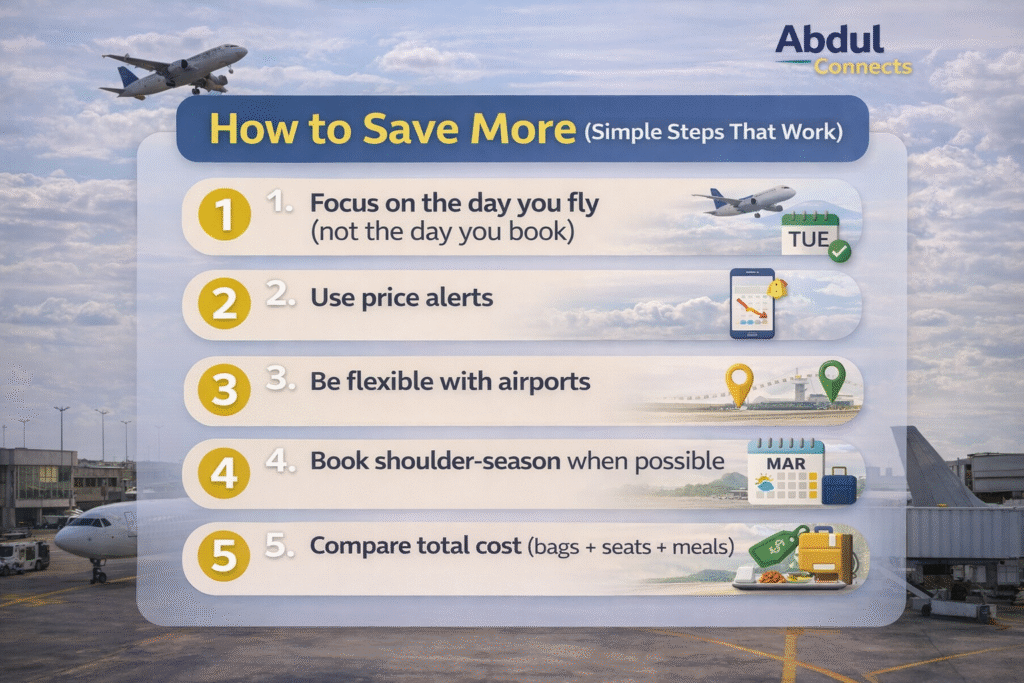
How to save more (simple steps that work)
1) Focus on the day you fly (not the day you book)
A Wall Street Journal travel myth-busting piece (May 1, 2025) discussed how the old “book on Tuesday” rule doesn’t consistently hold in modern dynamic pricing.
Google’s own travel guidance also notes that the day you buy matters far less than people think.
2) Use price alerts
Set alerts in Google Flights or similar tools so you don’t miss a dip. Google’s travel tips encourage tracking prices rather than waiting for a “magic day.”
3) Be flexible with airports
Try nearby major airports (sometimes even 1–2 hours away). That alone can change prices dramatically.
4) Book shoulder-season when possible
Pairing shoulder-season travel with midweek flights is one of the most consistent ways to keep costs down.
5) Compare total cost (bags + seats + meals)
A “cheap fare” can stop being cheap once baggage and seat fees are added — especially on ultra-low-cost airlines.
Disclaimer
Do the research before making any decision, as this article is for informational reasons only. Flight prices and airline policies change frequently. If you need any assistance, send an email at hello@abdulconnects.com.