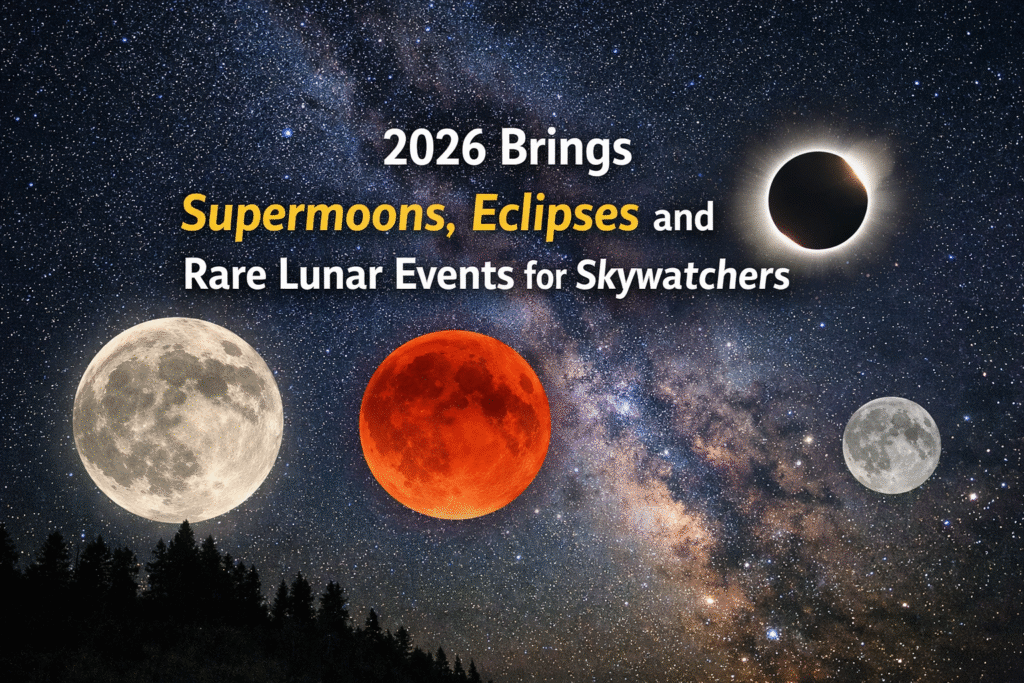
From a January supermoon to a springtime blood moon, the year ahead offers plenty of reasons to keep an eye on the night sky.
SEATTLE — Skywatchers will have a lot to look forward to in 2026, as the calendar is packed with eye-catching lunar events, planetary alignments and a rare total lunar eclipse visible in the Pacific Northwest.
The celestial show kicks off almost immediately. The year’s first supermoon arrives on January 3, when the full Wolf Moon reaches its closest point to Earth. Supermoons occur when a full moon coincides with perigee — the moon’s nearest approach — making it appear larger and brighter than usual. Weather may limit visibility in parts of Western Washington, but for those who catch a glimpse, it will be the last supermoon until November.
One of the most anticipated events of the year follows in early spring. On March 3, a total lunar eclipse will be visible across the Pacific Northwest. During the 58-minute eclipse, Earth’s shadow will completely cover the moon, turning it a deep red — a phenomenon commonly known as a blood moon. The last time North America saw a total lunar eclipse was in November 2022, making this a rare opportunity for local observers.
May brings another lunar oddity: two full moons in a single month. The first rises on May 1, followed by a second full moon on May 31, often referred to as a blue moon. Both of these will be micromoons, meaning the moon will be at or near its farthest distance from Earth.
A micromoon is essentially the opposite of a supermoon. It occurs when the moon reaches apogee, its most distant point in orbit. While the difference may be subtle to the naked eye, a full micromoon appears about 12 to 14 percent smaller than a full supermoon. The May 31 full moon will be the smallest of the year, sitting roughly 252,360 miles from Earth, compared to the average lunar distance of about 238,900 miles.
Beyond the moon, 2026 will also feature periods when bright planets line up in the night sky, offering easy viewing even without a telescope.
Taken together, the mix of supermoons, micromoons, a blue moon and a total lunar eclipse makes 2026 an especially strong year for astronomy fans — or anyone who simply enjoys stepping outside and looking up.